The space between two blues
A close reading of Cézanne’s view from L’Estaque, with a simple paper mask for comparing the blue of the bay and the hills beyond it.
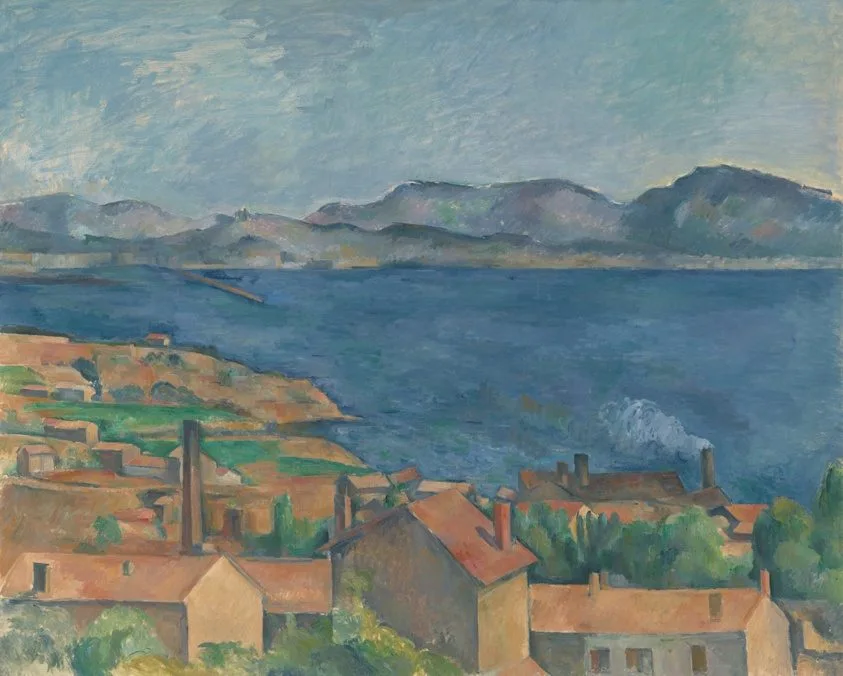
On the lower left, a roof rises into a patch of warm ground. Farther to the right, an orange chimney catches the eye. Cover the upper half of the painting with a slip of paper and these small warm shapes can almost crowd out the idea of a bay. Pull the paper down just enough to reveal the water. The same roofs now sit below an expanse much larger than themselves.
A blue with an edge
Look for the far shore. The line that separates water from hills is much less insistent than the sides of the buildings below. Lay the straight edge of your paper along it, then tilt it slightly. The hills have shallow rises and dips that are easy to overlook when the image is small. A mechanically straight division across a sketch will turn the bay into two stacked rectangles.
Borrow the roof colour
On a spare sheet, draw a small blue rectangle for the water. Place a warm patch against its lower edge and leave a little paper visible next to it. Make a second version with the same blue and a cooler, duller patch. Put them at arm’s length. The shift in temperature makes the blue feel different even though you used the same pencil both times. Return to the painting and see where green interrupts the sequence of warm roofs.
Give the foreground some weight
Find the verticals near the bottom edge. They are short compared with the long sweep of the water. Cover one with your fingertip. The foreground may feel flatter or the water more prominent. Repeat this with a different vertical before deciding which one to keep in a thumbnail sketch. Copying every wall and window gives the eye a great deal to do before it reaches the shore.
Back to the full canvas
Read the title after the exercise. From L’Estaque establishes a place from which someone is looking. We have spent the exercise crossing the image in the other direction, working backward from the distant blue to the small edges that establish that point of view. The museum’s full reproduction is worth opening for a last look at the transitions around the roofs.