A bend and a boundary
Trace a watercourse, a field edge and the wedge of ground between them in an aerial photograph of California’s Sacramento–San Joaquin Delta.
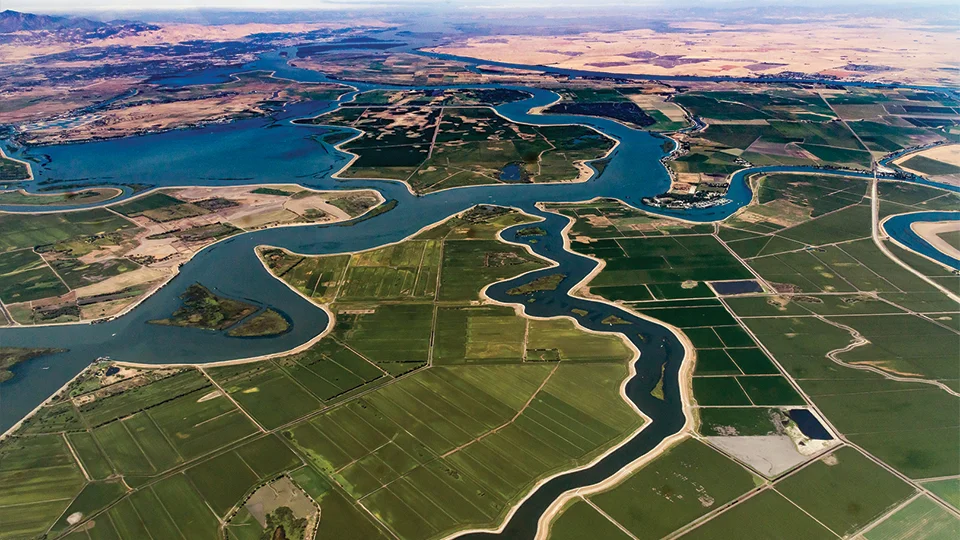
Start beside the pale road at the lower right of the photograph. Above it a dark channel makes a series of tight turns. Farther back, much broader water opens out to the left. On a map it would be natural to ask where the channel goes. On a sheet of drawing paper, the first question is where it changes direction.
One bank at a time
Put a postcard-sized rectangle on a sheet of scrap paper. Choose the bank of the channel nearest the centre and follow just that bank with the point of a pencil. Lift the pencil when the water divides. If you trace both banks on this first pass, the shape starts to look like a strip of ribbon; following one leaves you free to notice a brief straight reach between two curves.
The field has a different clock
On a fresh rectangle, draw the longest straight edges in the foreground. Stop at each corner. Compare that movement of the wrist with the turn you made for the river. There is a pause in one drawing and a continuous sweep in the other. A row of crops, a track and a boundary can have the same direction in the image. Keep their identities open until you have drawn the lines you can actually see.
Give the leftover ground a name
Choose one small wedge between a bend and a straight field edge. Shade the entire wedge with the side of the pencil. Set the photograph aside and look at the drawing upside down. Is the wedge wide enough at one end to tell you which way the river turned? If it is, the unshaded channel can read as water even without a single ripple.
What the photograph can carry
The USGS credits this image to The Freshwater Trust. Its caption identifies the larger delta; it does not identify each parcel in the view. Put that caption on the back of the drawing. On the front, write one observation that belongs to this particular photograph: the curve you lost, the corner you sharpened, or the narrow piece of ground that held the two together.